


Then and Now: Comparing the 2023 Chevy Bolt to the 2027 Chevy Bolt
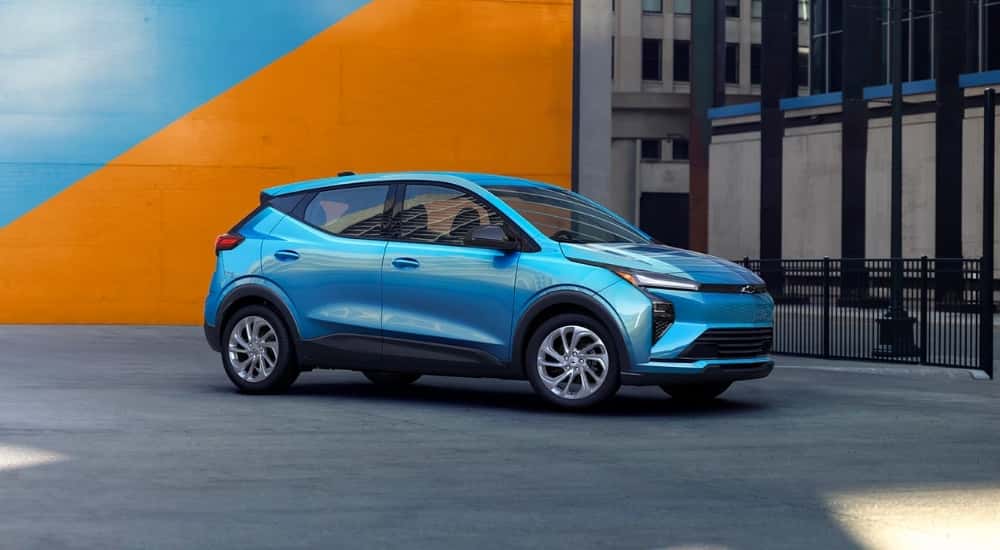
Remember the Chevy Bolt? Not so long ago, it was one of the original players in the modern electric vehicle (EV) game. Then, just when the EV scene was starting to really heat up, Chevy pulled the Bolt from their lineup. In July 2023, General Motors Chair and CEO Mary Barra quietly announced that the Bolt would not return for 2024, but instead undergo a comprehensive refresh, redesign, and re-engineering in preparation for a 2027 reboot.
Though it will still be a while before you can find a Chevy Bolt for sale, details have emerged about the latest and greatest version of this EV superstar. It seems that Chevy is committed to the small stature and all-electric status of the Bolt, though of course, times and tastes have changed. Take a look at how the all-new Chevy Bolt has evolved to capture the hearts of an all-new audience of drivers.
Looking Back at the First Chevy Bolt
The Chevy Bolt first hit the streets way back in 2017. In those days, hybrids were a familiar enough product, but fully-electrified vehicles were still somewhat of an oddity. However, the versatile four-door, five-seat hatchback format, 238-mile range, and 90 mph top speed made it a favorite among drivers seeking a small, agile vehicle that didn’t cost a lot to own.
The little EV that could continued for six years of production, giving drivers exactly what they wanted when they needed it. As a subcompact hatchback, the 2023 Chevy Bolt is on the smaller side, but not so small that it’s impractical. Rear seat passengers receive a decent 36 inches of legroom, and the cargo space extends from 16.6 cu.ft. to 57 cu.ft. once the rear seats are folded.
The Bolt EV was later joined by a big brother, the Bolt EUV, for the 2022 model year. While the Bolt EV resembled other economy-minded hatchbacks of its time, crossovers and SUVs were all the rage, and Chevy gave the people what they wanted by making a crossover version of the Bolt. It had the same running gear as the hatchback, but a larger body, and a slightly larger price tag.
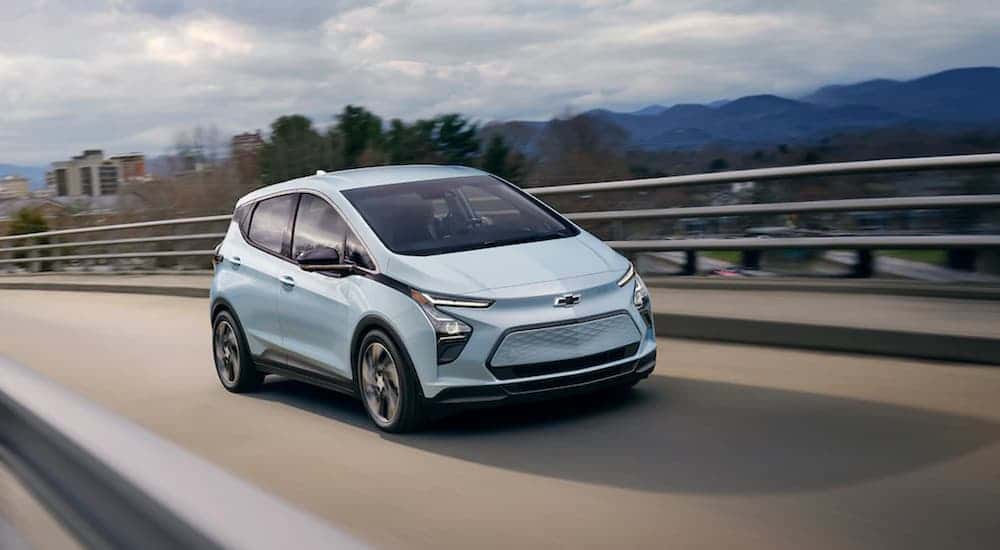
What Kind of Technology Did the 2023 Chevy Bolt Include?
We are at a truly impressive stage in automotive technology. Just ten years ago, huge infotainment touchscreens and driver assistance tools were still in their infancy. However, the Chevy Bolt has been fully tech-invested since its debut. By the 2023 model year, all models included a standard 10.2-inch infotainment touchscreen with standard wireless Apple CarPlay and Android Auto, as well as an eight-inch digital information display.
Offered in 1LT and 2LT trims, standard features for the 2023 Bolt EV also included keyless entry and remote start. Stepping up to the 2LT trim provides drivers with perforated leather seating and a heated, leather-wrapped steering wheel. The 2LT models were also eligible for an optional seven-speaker Bose audio system and wireless device charging. Option packages were similar for the Bolt EUV, but were called the LT and Premium trims instead.
Both 2023 Chevy Bolt models are outfitted with Chevy Safety Assist driving tools, including forward collision warning with automatic emergency braking, automatic high beams, and lane-centering assistance. The 2LT trim adds a 360-degree exterior view, rear parking sensors, and blind-spot monitoring with rear cross-traffic alert. While the Bolt EV has never been a luxury car, it has remained true to its promise of keeping electric vehicles accessible for a variety of budgets. What might seem like a lackluster list of features is actually a carefully planned arrangement of everything that makes driving enjoyable at a price point that doesn’t break the bank.
Introducing the 2027 Chevy Bolt
At the time the Bolt left the American market, it was widely accepted that we were gearing up for an all-electric future. However, many things have changed since 2023, and the future of EVs is questionable. As a result, the return of the Bolt seemed uncertain. However, in October 2025, Chevy announced that the Bolt is still very much a part of its 2027 plans.
Soon, the Bolt will be back and better than ever as one of the most cost-effective EVs available, with a projected starting MSRP under $30,000, according to Chevrolet. The new 2027 model drops the EV and EUV designations and is known simply as the Bolt. At first glance, it looks quite familiar, with a similar crossover shape and subcompact size as the previous Bolt EUV. Cargo volume measurements are pretty much the same as they were before, too, with 16.2 cu.ft. behind the rear seat and 56.3 cu.ft. available when the rear seat is folded.
Power and performance, however, have been improved. The 2027 Bolt uses the X76 drive unit, making it the tenth vehicle in Chevy’s lineup to use this drive unit. Now with up to 255 miles of range on a full charge, the new Bolt offers 210 hp and 169 lb-ft of torque. It also charges faster. A native public charging port allows drivers to charge their battery rapidly at a public charging station. In fact, a Bolt can be charged from 10% to 80% in 26 minutes with DC public fast charging, making it an even more worthy contender for long trips and lengthy daily commutes.
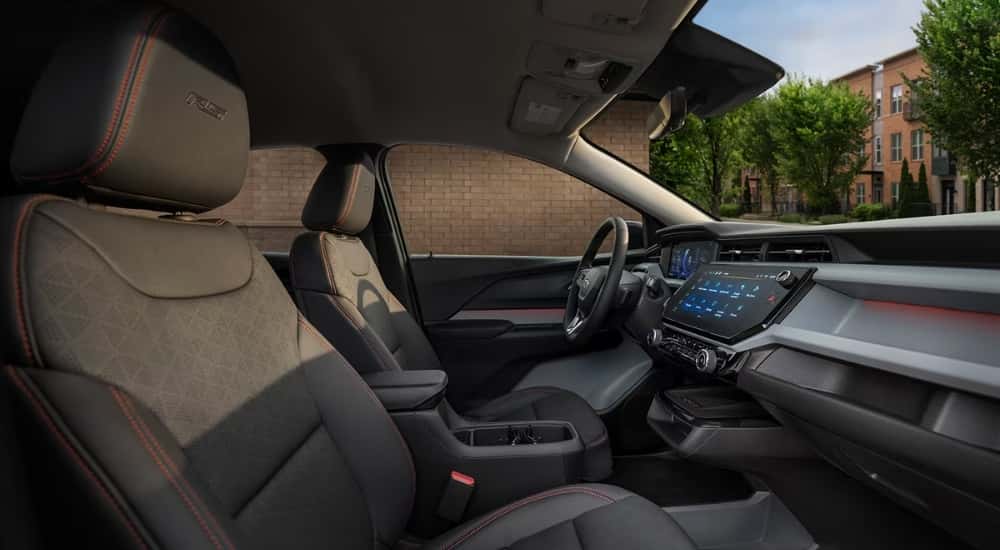
A Bolder, More Tech-Forward Bolt
Much like the 2023 version, the 2027 Bolt takes tech seriously, providing drivers with the tools they need to stay safe and connected on the road. Chevy has confirmed that the 2027 Bolt will feature over 20 standard safety and driver assistance aids, including Adaptive Cruise Control, front and intersection collision avoidance with automatic braking, and Blind Zone Steering Assist. With the available Tech Package, drivers can add HD Surround Vision and an HD Rear Vision Camera Mirror, in addition to Traffic Sign Recognition.
Available Super Cruise hands-free driving technology pairs with Google Maps to help you take the stress out of longer commutes. This Google Maps integration also takes into account your battery range, providing the most battery-conscious routes. It can also offer the best charging options in your area, with real-time calculations of your range and charging status, providing a clear picture of how urgent charging is.
In the cabin, a large 11.3-inch screen helps you access the infotainment system. With Google Built-In, you’ll have greater access to apps and the internet, allowing you to play games, stream movies, or browse the internet while the Bolt is parked or charging. Behind the wheel is an 11-inch driver information screen, which provides vehicle details. Additionally, Chevy promises multiple USB-C ports throughout the cabin. Chevy has indicated that the 2027 Bolt will be equipped with Vehicle-to-Home bi-directional charge capability, meaning your Bolt could help power your home in the event of a power outage.
Stay Tuned for More from the 2027 Chevy Bolt EV
Limited-run Bolt EVs are expected to start hitting the roads in 2026, while orders for the LT and RS trims are expected to be fulfilled in 2027, with more information and trim details being announced closer to the launch date. For many drivers, the Bolt EV provides an ideal vehicle. It’s not too big, not too small, agile in the city, and equipped with a long range that helps it go the distance. Even better, it’s a hassle-free way to drive, with fewer random, urgent stops at gas stations, and more organized, well-planned stops at the charging station while you work, grab a bite to eat, or check out local happenings.


0 comment(s) so far on Then and Now: Comparing the 2023 Chevy Bolt to the 2027 Chevy Bolt