


What’s the Difference Between the Chevy Blazer and Blazer EV?
For years, all we’d hear was chatter about how big-name manufacturers were about to join the battle of hybrids and EVs to get a leg up in the competition in the wake of the sales success of consumer-grade hybrids like the Prius, combined with the technology that made these fuel-saving vehicles viable. Now, in almost the blink of an eye, it seems that EVs are coming out of the woodwork from every corner of the industry, and the 2024 model year has been rifled with anticipation from everyone.
Among the vehicles coming out for the 2024 model year, Chevy is releasing the Silverado EV and the Blazer EV – two big names that Chevy is expecting to make a sizable splash within its lineup and every lineup with popular SUVs. If you’ve been shopping for a Chevy Blazer for sale, then you should take a moment and listen to what we have to say because it could greatly impact the decision you’re about to make with your money.
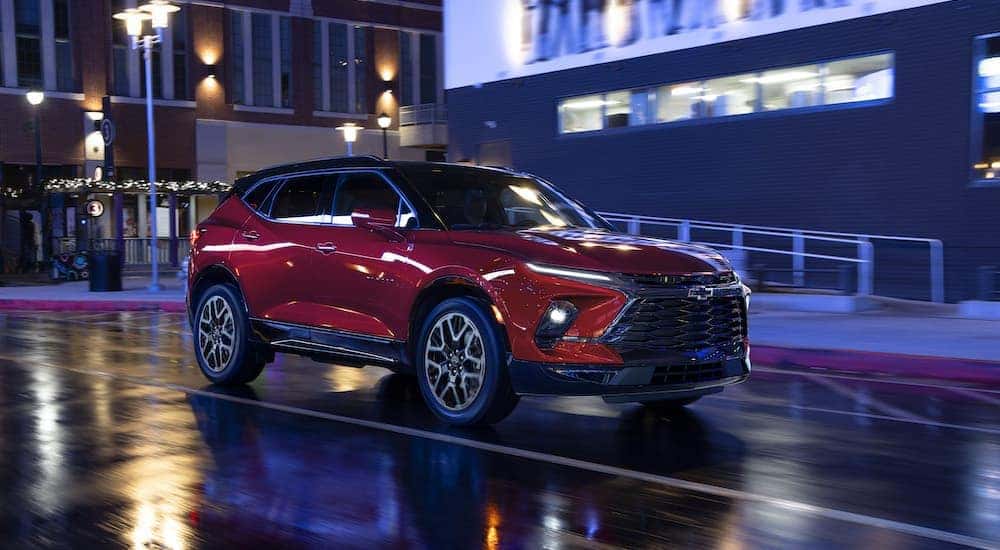
Unlike dedicated hybrid trims, as we’ve seen in countless vehicles, the switch to the Blazer EV isn’t a matter of switching from one trim and powertrain to another, but it’s a separate vehicle with a different set of rules it follows. Simply put, for all their similarities, the Chevy Blazer and Blazer EV are nowhere near the same vehicle. The similarities mostly end after the vehicle class and the badging it proudly parades on the front of its grille. However, there’s enough familiarity to be a welcomed change – but not overly drastic – for drivers who wish to switch to the Blazer EV from their traditional gasoline-powered Blazer. There’s a lot to discuss, so let’s dive in head-first.
What We Know (And Don’t Know) About The Chevy Blazer EV
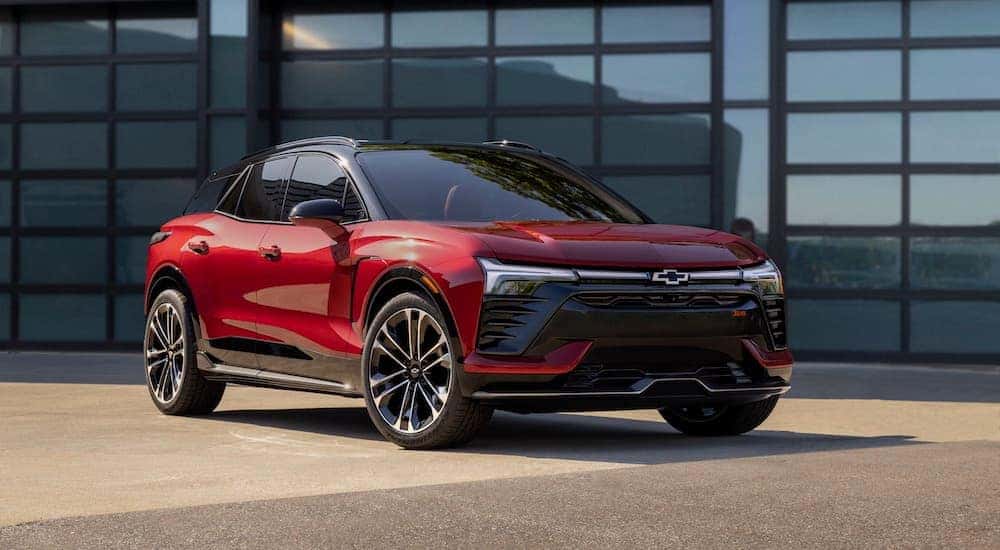
Much of the Chevy Blazer EV’s underpinnings have been confirmed via the manufacturer, but that doesn’t mean some info has yet to be brought to fruition, meaning, unfortunately, speculation is still on the table in a few areas until enough of these models get in the hands of drivers. Firstly, the Blazer and Blazer EV will both sport the same maximum passenger capacity of five, but there’s a chance the Blazer EV’s interior will promote slightly more roomy measurements than the regular Blazer. This is something still left up to speculation, but we’ll all have this information soon.
We know the Blazer EV will be a slightly more premium take on the interior design, which is also evident by the price increase between the Blazer and Blazer EV. However, keep in mind this is no different than what we’ve seen elsewhere, as EV variants of popular models are regularly pricier because they not only include electric-powered powertrain components, but often the tech and materials they’re made with are a step above. This is what we’ll be seeing with the upcoming Silverado EV, too. As you’ll soon learn, the price increase is also attributed to greater performance, which isn’t feasible on the regular Blazer.
The Blazer EV’s performance is another aspect where we know as much as we don’t based on currently available information. For example, it’s confirmed there are three available powertrains for the Blazer EV: an 85 kWh battery with either one or two motors and a 105 kWh battery with two motors that’ll only be on the Blazer EV SS trim. Although there’s no concrete data on what type of power the single motor variant of the 85 kWh battery will produce, we know this powertrain will have RWD and will sport the highest mileage range of the three Blazer EV powertrains with 320 miles. The 85 kWh and 105 kWh batteries with two motors have more narrowed-down estimates of what you can expect, with the former estimated to produce 288 hp and 333 lb-ft of torque and the latter with an estimate of 557 hp and 648 lb-ft of torque.
Regarding those two remaining Blazer EV powertrains, how many miles will each one sustain on a full charge? We already mentioned the standard battery with its singular motor will travel 320 miles before the next charge, but the 85 kWh battery that comes with an extra motor and an all-wheel drivetrain gets a reduction down to 279 miles on a full charge. Still, this 13% reduction is the largest gap of the bunch, so it’s a relatively minute hit to the Blazer EV’s power efficiency, switching to what we’re sure will be a stronger powertrain compared to the base one thanks in large part to the second motor. However, it’s once again worth noting: the horsepower and torque output of the standard 85 kWh battery with one motor is yet to be confirmed via official Chevrolet sources.
Lastly, how does the 105 kWh battery with its two motors compare regarding travel ranges? The larger battery sports a higher capacity, so the mileage range of 290 miles is greater than the 85 kWh battery with dual motors, even with the expected 93% and 95% increase in horsepower and torque, respectively, with the larger battery. Something we also don’t know yet is how much weight the Blazer EV can tow. We do know the 2024 Blazer can tow between 1,500 lbs and 3,500 lbs, depending on which of the two engines you have.
How Do They Compare?
Based on the information provided to the public by Chevrolet, it’s clear this type of performance is unprecedented with any vehicle adorning the Blazer name. A brief look at the most performant 2024 Blazer models, and you’ll see it comes with a 3.6L V6 engine with 308 hp and 270 lb-ft of torque. This means the Blazer EV’s strongest model outputs 81% more horsepower with a 140% increase in torque output based on the estimated 557 hp and 648 lb-ft of torque we previously mentioned. This should come as no surprise as the 105 kWh battery and its two motors only come with the SS trim, which is estimated to have an MSRP of around $65,995, which is a meaningful jump over the 2024 Blazer RS’s MSRP of $42,800, which is the first on the list of 2024 Blazer trims to come with the 3.6L V6 engine standard.[a]
Before we wrap up, let’s compare how the Blazer EV with the best mileage range – the 320-mile range stamping from the 88 kWh battery with the single motor – compares against the most fuel-efficient 2024 Blazer. The most fuel-efficient 2024 Blazer is the one with the turbocharged 2.0L I-4 engine, which these models receive EPA-estimated ratings of 22 MPG in the city and 29 MPG on the highway (25 MPG combined) with FWD; AWD models get 22 MPG in the city and 27 MPG on the highway (24 MPG combined.) The 2024 Blazer has a fuel tank that holds up to 19.4 gallons of fuel, so a total mileage range of 485 miles is in order. An impressive showing for both SUVs and a fantastic mileage range for the Blazer EV as Chevy’s first EV SUV – the Chevy Bolt EUV – only drove up to 247 miles on a single charge, so Chevy’s EV chops have seen some upgrades following the discontinuation of the Bolt EUV, and we’re all excited to see it.

Which Blazer Are You?
The 2024 Blazer EV is likely going to establish a strong foothold in the EV SUV space, not only because of marketing promises coming to fruition but because the regular Blazer is one of the most respected SUVs on the market. However, these two SUVs are not alike, but they are. The Blazer EV deserves its namesake, but it’s marketed at almost a different driver: the greener driver interested in SUVs and electric powertrains.
This comes at a cost, but if you consider the money you save in the long run by switching to electricity rather than fuel, then it’s an investment that eventually pays for itself. The Blazer isn’t going anywhere, and the existence of the Blazer EV could be nothing but great news for the gasoline-powered SUV as there could eventually be a form of feature parity, with the main difference being the resource that makes everything move, whether that be fuel or electricity.


0 comment(s) so far on What’s the Difference Between the Chevy Blazer and Blazer EV?