


How the 2025 Chevy Blazer EV Is Superior to Its 2025 Honda Prologue Rival
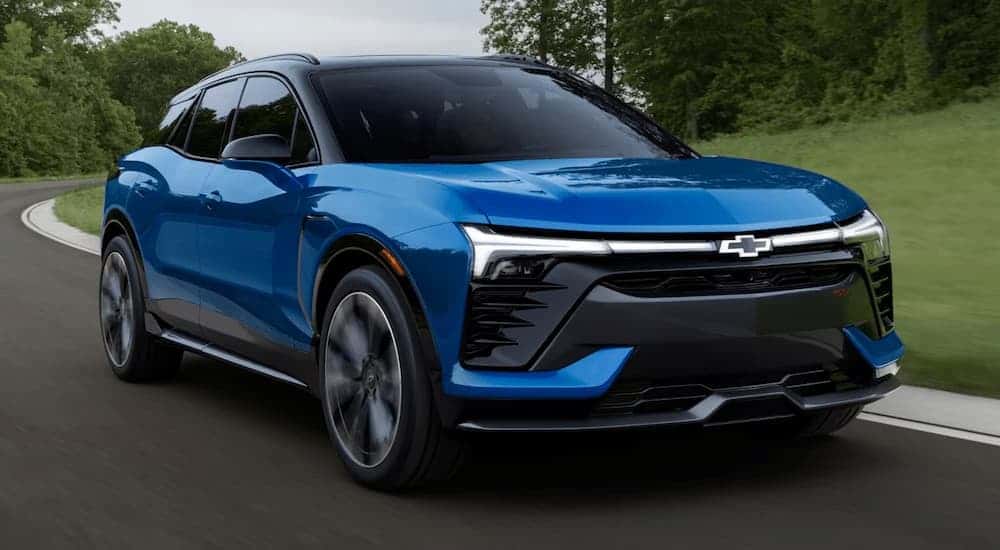
It’s a great time to purchase a midsize all-electric SUV. But which one should you buy? That’s what we’re here to assist you with today. We’re here to examine the 2025 Chevy Blazer EV vs 2025 Honda Prologue debate and help you decide which deserves your time and hard-earned money. We’re confident that you’ll see that the Blazer EV is the superior model. From performance to range to interior space, this model comes out on top in a variety of important categories. Let’s take a closer look at why you should consider the Blazer EV, and when you’re ready to experience it in person, we invite you to visit us at DePaula Chevrolet and take a test drive.
Both Share the Same Platform, But Are Still Very Different
The 2025 Blazer EV and 2025 Prologue’s base models—the Prologue EX and the Blazer EV LT—have a lot in common despite their differences. This is mainly because they share the same platform. However, Chevy goes one step further by providing a real, meaningful upgrade for the 2025 Blazer EV, thanks to a new trim called the SS, powered by an exclusive powertrain.
Each base model uses an 85 kWh battery and is standard with a single motor. This makes it more like the 2025 Prologue’s base powertrain. Both are available with two motors and the horsepower and torque output scales accordingly between the two. The 2025 Blazer EV and Prologue’s base powertrain—the 85 kWh battery and single motor—combine for 220 hp and 243 lb-ft of torque. With the second motor introduced, both the Prologue and Blazer EV push 300 hp and 355 lb-ft of torque. The Blazer EV inherently has the advantage because it’s the more cost-effective vehicle of the two, with its entry-level price tag coming in at $44,600, while the base Prologue will cost you a hefty $47,400.[a] Starting to see a difference?
Do things get better for the 2025 Prologue? Unfortunately, no. The 85 kWh battery is the largest available for the Prologue. The upgraded powertrain for the 2025 Blazer EV pushes beyond the 2025 Prologue’s limits, with a large 102 kWh battery—a 20% larger battery than the Prologue’s—paired with a single electric motor to create 365 hp and 325 lb-ft of torque.
In what’s the final nail in the coffin, the 102 kWh battery receives a second motor with the SS trim, leading the Blazer EV to create an impressive 615 hp and 650 lb-ft of torque. This is 105% more horsepower and 83% greater torque output than what the 2025 Prologue is capable of. The 102 kWh battery also allows the 2025 Blazer EV a maximum towing capacity of 3,500 lbs, more than double that of the 2025 Prologue’s lackluster capacity of 1,500 lbs.
A Look at Charging Options and Range
The 2025 Blazer EV and Prologue are EVs (electric vehicles), meaning there’s no reason to use gasoline or diesel. Instead, you’ll plug your vehicle in to charge its battery, much like your phone, laptop, or any other wireless device. This understandably raises a few questions and concerns for those who have never driven an electric vehicle.
It’s up to the car manufacturers to address the public’s concerns about switching from tried and true gasoline as a fuel source to a fully electric powertrain, and the best way to address concerns is by providing real results. Seeing is believing in the automotive world for many, and EVs have come a long way since their inception and now stand tall amongst their gasoline-powered counterparts, with concerns ranging from safety, performance, and especially efficiency all having been addressed.
Nobody wants their battery-powered car to die while in the middle of the road, and nobody wants to spend all day charging their car for a few dozen miles. Plenty of tech has been developed to accommodate EV drivers with as much help as possible, including features designed to prolong battery life. Chevy and Honda each offer three levels of charging. Level 1 chargers are basic charging solutions and provide the slowest charge, but both the Blazer EV and Prologue support 240V Level 2 chargers available for at-home installation. Chevy and Honda’s midsize EVs also support DC Fast Charging at public charging stations found at shopping malls, movie theaters, gas stations, and more.
It’s fair to say that both manufacturers understood the assignment of efficient charging speeds for the Blazer EV and Prologue, but that doesn’t mean both passed the efficiency test with flying colors. Unsurprisingly, the Prologue’s base powertrain offers a higher travel range on a full charge because it uses a single motor, with an impressive 308 miles compared to 294 miles with a dual-motor setup. However, Chevy’s upgraded powertrains tell a different story because the Blazer EV’s 102 kWh battery with its single motor is not only stronger than the Prologue’s 85 kWh battery and dual motors, but it’s more efficient too, with an estimated 324 miles on a full charge compared to 294 miles.
Sizing Up the Competition
The 2025 Blazer EV sizes up its competition by providing a larger interior than the Prologue. It gets more from its mid-size body: another advantage over the Prologue. The 2025 Blazer EV and Prologue have maximum passenger capacities of five, and folding the second-row seats is an option whenever you need extra cargo space if nobody is seated behind you. Midsize EVs must offer ample cargo room in either scenario, especially when the family is tagging along for a road trip because they must accommodate each person’s luggage and other belongings.
The 2025 Blazer EV has more cargo space than the 2025 Prologue. This is true when the back seats are folded and vice versa. The 2025 Blazer EV has 25.5 cu ft. of space in the default configuration; lowering the second-row seats increases this available cargo space to 59.1 cu ft.—132% more room. The 2025 Prologue, by comparison, has as little as 23.7 cu ft. when all passengers are aboard, and 54.5 cu ft. when the back seats are folded. However, the EX fares better, with between 25.2 and 57.7 cu.ft. depending on whether the back seats are upright. That’s still not as great as what you’d get with the 2025 Blazer EV.
Does the 2025 Prologue’s interior have size advantages over the 2025 Blazer EV? There are only a few, including rear-seat passengers, getting 39.4 inches of legroom in the Prologue over the Blazer EV’s 38.9 inches of rear legroom, though that’s less than half an inch difference. You and your front-row passenger will have 40.8 inches of headroom and 44.2 inches of legroom over the 2025 Prologue’s 39.6 and 41.4 inches of front-row head and legroom. Passengers sitting in the second row will have an identical 38.1 inches of headroom between the two BEVs unless the Prologue is a Touring or Elite trim, where it’s lowered to 36.7 inches.

We Could Go On and On…
We could go on about the 2025 Blazer EV because, in many ways, we’re just scratching the surface. For example, did you know that the 2025 Blazer EV has a massive 17.7-inch infotainment center over the 2025 Prologue’s 11.3-inch infotainment center? The Blazer EV has more up its sleeve than you may realize. The 2025 Prologue’s problem is that it comes close to the 2025 Blazer EV in many ways, but rarely achieves better results. It also costs more, with a starting MSRP of $47,400 instead of $44,600.[a] You can easily spend hours reading about Chevy’s incredible midsize EV, but you now know more than enough to begin shopping. We hope this guide has helped make your decision easier! Come in today and let our team show you everything the thrilling Blazer EV has to offer.


0 comment(s) so far on How the 2025 Chevy Blazer EV Is Superior to Its 2025 Honda Prologue Rival