


The Technology of Modern Chevy

Saying a modern gadget or trinket has more processing power than the Apollo 11 spacecraft that put men on the moon might be a cliche, but it is often true. A modern Chevrolet is not just any gadget, however, and some of the solutions and technologies involved in the latest Chevy vehicles are truly impressive. Many of these innovations are software related, but many more have to do with advanced materials, precise sensors, and thousands of hours of wind tunnel testing. Chevrolet has worked hard to leverage the advancements of the modern world to keep their vehicles on the cutting edge of vehicle technology. Here at our Albany Chevy dealership, you will find models filled with all kinds of advanced technology designed to keep you safe and comfortable on the road.
Safety Technology
Few parts are more important to the safety of a car’s occupants than the brakes. Braking systems on modern Chevrolet vehicles generally feature tough metal rotors that are clamped onto by high-friction pads. These pads are controlled by a caliper, which actuates the pads when the brake pedal is pressed. While the simple hydraulic system that boosts the pressure applied at the pedal to be able to handily stop a heavy vehicle has been around for some time, the software and sensors that assist the driver in applying the brakes safely are consistently upgraded and represent the latest technology available. The Anti-lock Braking Systems used on modern Chevys can modulate brake pressure several times per second to help a vehicle stop on a slick surface. On many models, the system can even work in conjunction with other vehicle sensors to stop autonomously in an emergency, such as when an unseen pedestrian walks in front of the vehicle.
While the Apollo 11 comparison might be appropriate when discussing onboard computers and processing power, the battery of sensors installed on all modern Chevrolets is more akin to the technology on military aircraft. The main difference is that on a Chevy, sensors do not guide weapons to a target but keep one’s vehicle as far from harm’s way as possible. The onboard sensors that can be optioned on Chevrolet vehicles include cameras and radar, and their outputs are not just given to the vehicle’s computer systems but also to the driver. These alerts are often given via visual and audio cues, but also through Chevy’s unique vibrating Safety Alert Seat technology.
For the accidents that can’t quite be avoided, airbags are there to save lives. These devices can deploy from hidden compartments far faster than the blink of an eye, protecting the occupants of a vehicle in the midst of an accident. Many modern Chevy cars and trucks have advanced dual front airbags, as well as curtain airbags.
Performance Technology
Going fast requires power, and preferably lots of it. A bigger engine is rarely a standalone solution, however. With extra size comes extra weight, bulk, cooling requirements, and emissions. The main improvement in engine technology over the past decade has been increasingly precise and diverse applications of computer control. This now often includes direct fuel injection, variable valve timing, variable intake length, variable exhaust, and a host of other electronically optimized components.
Power is nothing without control, and tires are the unsung heroes that allow cars to grip the road firmly mile after mile. Modern tires are constructed differently from their forebears from the ground up, and their tread patterns and rubber compounds have been meticulously developed over many years to offer the perfect blend of comfort, grip, water evacuation, quietness, and longevity for every specific application. This is most apparent with high-end performance tires, which equip such vehicles as the Corvette. The high-performance street tires of today offer similar grip levels to the pure racing tires of just over a decade ago.
Tires are important, but helping them stay glued to the road are highly refined and technologically advanced suspension systems. The shock systems employed by cars like performance models of the Corvette have magnetorheological properties. Through the use of “smart” fluids that can change their attributes when different electric currents are applied, the shocks can adapt several times per second to perfectly match the road conditions and provide the greatest possible grip. These kinds of shocks are commonly optioned on Corvettes and Camaros for street use but are also available on off-road and luxury models like the Tahoe and Suburban.
Efficiency Technology
Modern Chevrolets are made to be as economical and ecologically conscious as possible for their given purpose, and the most outwardly apparent evidence of that is how they cut through the air. Similar to the rigorous process that aircraft and missiles are put through, many Chevrolet vehicles have their bodywork optimized in the wind tunnel, especially on hybrid and performance models. Being able to slice through the air while causing as little disturbance as possible is of paramount importance to hybrids to achieve the best fuel economy possible. For performance cars, low drag and high downforce are just as important for maximum speed and grip.
The metals and composites that form the backbone and skin of modern Chevys are a far cry from what older and less advanced vehicles are comprised of. Modern Chevrolets from the least to the most expensive are all built with modern metal alloys that have been specifically developed for high strength and low weight. These materials are bonded together in ways that not only ensure chassis rigidity and longevity but also impact absorption in case of an accident. As technology continues forward, more and more cars make use of aerospace-derived carbon fiber composites, which allow engineers to precisely tailor how strong a surface is under a certain kind of load. This drives weight down further while increasing strength.
Power and efficiency are no longer diametrically opposed. With Cylinder Deactivation, fuel flow can be halted to certain parts of an engine while the rest continue to run, allowing a burly V8 to be very nearly as efficient as a four-cylinder when the unneeded cylinders are turned off. When fuel is once again provided to all cylinders, full power is instantly restored. The transition is largely seamless thanks to computer control.
Luxury Technology
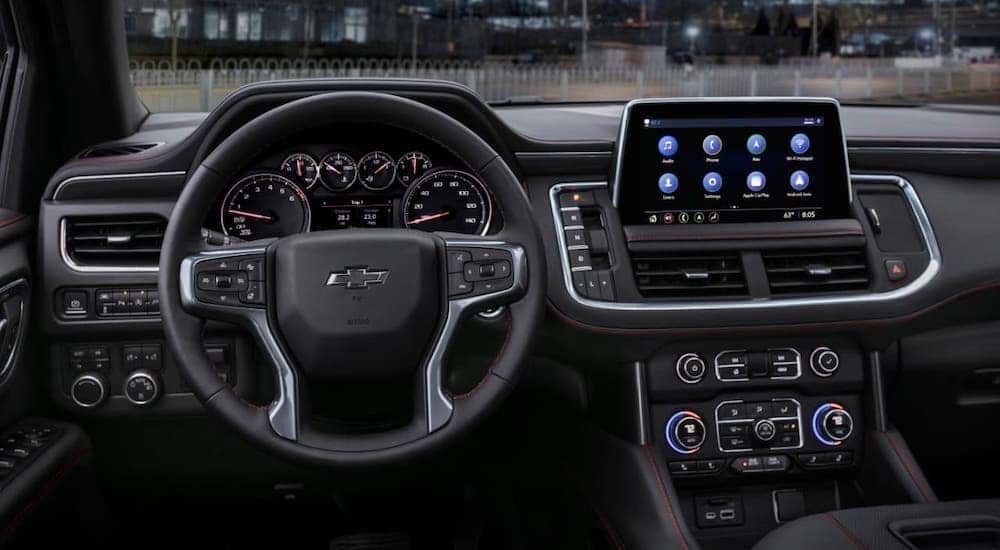
One of the first amenities cars were adorned with is now updated for the new century. Instead of CD players and radios, Apple Carplay and Android Auto allow you to play your favorite music directly and seamlessly through your phone, as well as podcasts and other audio types. The old AM/FM radio is still available, but now there are more options than ever for you to enjoy, such as SiriusXM satellite radio and HD radio.
Mobile devices are more than at home in a modern Chevrolet. USB charging ports come with a wide variety of new Chevys, making it a snap to get your devices back up to a full charge. A 4G LTE WiFi hotspot is also offered on most recent Chevy models, so being connected on the go is now easier than ever.
Enjoy Modern Technology in a Chevrolet
Every vehicle in the current Chevrolet lineup offers impressive tech that was uncommon even in supercars of just a decade prior. From tires and engines to airbags and radar, modern Chevy vehicles come packed to the gills with advanced technology and innovative solutions. Significant amounts of time, effort, and research and development funding have gone into bringing all this new tech to the consumer as rapidly as possible, without sacrificing reliability or usability. These devices, vehicle construction methods, and materials work together to provide the safest, highest performance, and most efficient Chevrolet lineup ever. And all of these features are now available on cars straight from the showroom floor of DePaula Chevy.


0 comment(s) so far on The Technology of Modern Chevy